
Relaxing after a strenuous day
Altrincham Choral
Society Newsletter – November 2005
Musical Chairs
At
our recent AGM, held on 26 September, Pam Moult bowed out after 5 years as
Chairman.
And
what busy and successful years they have been!
In
addition to performing a wide range of both traditional and modern choral works
at the RNCM, we have sung with the ELO in the Bridgewater, given a concert
version of a G&S opera, toured in France and Italy, sung for Barnardos in
Stockport Town Hall and with Chesterfield Philharmonic in Chesterfield and
Sheffield, as well as appearing alternate years at Cartmel and giving two local
carol concerts each Christmas, partly for charity.
Initiatives
introduced during Pam’s tenure have included: the Newsletter, an annual Singing
Day and open rehearsal, a Marketing Study, a Funding Team, a Publicity Team, an
annual charity shop, an annual dinner with cabaret, Patrons and Sponsors, the
move to Altrincham Methodist church – and a new ACS logo.
The
choir itself is in great shape, membership is rising, our financial position is
sound and our website is attracting more and more attention from potential
singers and audience.
So,
well done, Pam, and many thanks for five years of inspiration – and
perspiration! – and also thanks to the large number of
largely unsung helpers who - week in, week out - make it all happen.
Dudley
Harrop was elected the new Chairman.
Singing
Day
Everybody is welcome to this day
– an opportunity to sing some exciting music from scratch, and bring some
friends along (particularly tenors!) to find out more about Altrincham Choral.
Rutter - Requiem
Fauré - Cantique de Jean Racine
Items
from Encores for Choirs 2
Storms
over San Margherita
Proudly showing off our ACS T-shirts, we made our way to rehearse in
our first Venetian venue, a church now converted into a college auditorium in a
classical style. It felt manageable and had good acoustics. We missed our usual
colleagues (yes, honestly!) but it made for an interesting change.
There was another transformation. Jane and Ann had already given two
great performances in
As the evening performance approached, the skies darkened and some of
us collected umbrellas before setting off along the miles of canals and
passages to San Margherita. Sure enough the heavens opened and the
choir’s stragglers got well and truly soaked - not that the early party could
feel smug because they got hopelessly lost and somehow managed to detour via
San Rocco!
Musically this was arguably the best of our four concerts. It was
atmospheric too, with some of the audience perched on the balconies and a
dramatic electric storm for accompaniment. Just before the end of the encore a
local woman jumped to her feet shouting “Bravi, bravi!”.
Before and after the concert there was a lot of organisation going on
in the background, mainly by Pam but with others helping in all sorts of ways. For instance, Helen reluctantly tore herself away from
parental duties to act as Steven’s Italian speechwriter and we were really
impressed when Steven launched into fluent Italian.
San Stefano - simply
stunning
This venue seemed curiously named because none of us could think of
anyone called Steven who was particularly saintly. Those who forged ahead with
their sightseeing reported that the building was stunning, but nothing prepared
us for such a dramatic church - it was huge, with a wow factor even beyond
Cartmel.
The rehearsal gave a taste of what was to come. The acoustics were
extremely rewarding and required more than our usual clarity and precision
because the slightest errant voice could be detected. Our two soloists could be
heard just as well from a far corner as close by, though they reported that it
seemed a daunting place to fill.
Out in the heat, our marketing team were hard at work handing out
posters and many of us spent dinner recruiting from adjacent tables. Our ACS
T-shirts were also spreading the news.
The performance started with a reassuring audience of well over 100. Vivaldi’s Gloria and its solos went particularly well in
response to Steven’s earlier coaching and it was quite something to realise
that we had brought this work back to within a short walk of its origins!
The audience continued to shuffle in off the street and almost filled
this vast church to capacity, giving us more and more confidence. They became
increasingly attentive as the concert progressed.
Between the two linked Mozart movements, Steven’s hands still held
high, the audience were so enraptured they even tried to applaud. We put
absolutely everything into the stirring Beethoven finale “Hallelujah” and the
audience were overwhelmed. The priest decided that we had finished and rapidly
switched on all the lights and made a quick goodbye speech. But Steven stuck to
the plan and rewarded the audience with our two encores sung from memory. In
this fabulous church, sung faultlessly (the tenors managing their best ever “Irreprehensibilis est”), this was
the high point of all our summer concerts. There were even the beginnings of a
standing ovation. What a way to finish!
Caroline (Soprano 1) and Bob (Bass 1) Harris August 2005
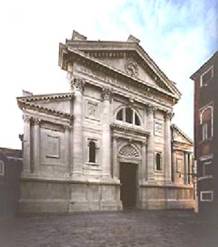
Just
a Façade?
As part of our trip to
Church architecture of this period used a lot of symbolism, and the
translation of the symbolism on the outside of this church was particularly
fascinating. The explanation of this is not generally recorded, but was passed
on to our guide by one of the friars who still lives there.
Most of the local worshippers could not read, and so the information to
be gleaned from this façade when it was originally created was an important way
of getting across the Church’s message.
The church was begun by Sansovino in 1534, in accordance with the
Renaissance theories of harmonic proportions, and replaced an older Gothic
church. Palladio rebuilt the façade in 1569 and this was his first major work
in
First of all, there are 2 tall statues set in the front wall: Moses,
described as “minister umbrarum” (the servant of shadows, but also the man who
took Jews out of the shadows of
Then there are 2 marble plates (both sides of the façade), which have
to be read together: “accede ad hoc ne deseras spirituale” = enter this (church) end never leave
(your) spiritual way, and “non sine jurgi exteriori interiorique
On top is the statue of a sick eagle. Usually the eagle is represented
as a bold and strong bird, close to God or any other deity. Here the eagle is
sick because it means that man also is sick until he enters the church to get
spiritual uplift, and regain his inner strength which enables him to fly up
high again towards God.
On the tympanum at the top is the dedication: “Deo Utriusque
Relaxing after a strenuous day
Making an exhibition of
ourselves
To accompany the recent AGM, Anne Bullock mounted a superb exhibition of photos, old programmes and press cuttings tracing the history of ACS over the last 60 years. She had managed to find an item from the Altrincham Guardian from July 1945 which mentioned the plan to form a choir in the district. The text of this letter is included in the programme for our current concert. Later items from the same newspaper described the first two concerts – reproduced below.
Anne also insisted on providing us with a wonderful selection of cakes and other goodies. Unfortunately, we weren’t able to stay long – Steven wanted to carry on with the rehearsal. Pity, really. Many thanks, Anne.
****************************
From the Altrincham Guardian - November, 1945
The Altrincham and District Choral Society was given an
enthusiastic reception when making its first public appearance at the Stamford
Hall, Altrincham, in a combined choral and orchestral concert organised by the
Hale North Wardens Committee. The proceeds were for the new building fund of
The concert was under the baton of Mr G.M. Forster. The soloists were John Harston and J. Morgan (tenors) and Gilbert Stewart (bass). Mrs Walker provided a skilful and sympathetic accompaniment.
From the Altrincham Guardian - Early
1946?
The newly-formed Altrincham and District Choral Society’s
concert at St Baldred’s Hall last week was given in connection with Hale
Thanksgiving Week, with proceeds going to the
Under the direction of Mr Forster, the choir, which at present is some 60 strong, presented a programme of choruses, part songs and solos. In most of the concerted pieces the attack was marked and the choir responded well to the conductor. It was evident that much conscientious work had been put into rehearsals.
In a programme which, very wisely, was not too ambitious, an outstanding item was an unusual setting of ‘Simple Simon’ given as a male voice quartet, in which the well balanced singing brought out some charming harmonies. Vaughan Williams’ ‘Sweet Day’ revealed a purity of tone highly creditable to a society formed as recently as September last. Not unexpectedly, the tenor and bass sections require more strength and when this defect has been remedied the choir’s progress should be interesting.
Humour was introduced by two masculine ‘young ladies’ who modestly hid their identity under the pseudonym of ‘The Twinkle Sisters’. A display of folk dancing was given by a party of six boys who cleverly wove their way through an intricate Northumberland dance and also performed a stick dance with cheerful disregard for their knuckles.
(Ed. – Interesting how so much hasn’t changed – conscientious work in rehearsals, purity of tone, lack of tenors and basses and, of course, the ‘charming harmonies’ of the male voices! And we HAVE become a cultural asset to the district!)